Hydroquinone vs. Tretinoin with Niacinamide
7 minute read
Summary
Hormonal changes during perimenopause and menopause can lead to dryness, uneven pigmentation, acne, and increased skin sensitivity. Hydroquinone, tretinoin, and niacinamide are commonly used ingredients that target different aspects of these concerns, from melanin production to cell turnover and skin‑barrier support. Their effects may differ in estrogen‑deficient skin, where barrier fragility and irritation risk can be higher. Understanding how each ingredient works—and how they can be combined safely—helps guide more effective and tolerable midlife skincare routines.
Perimenopause changes a lot of things: your energy levels, your mood, and yes, even your skin. The skincare routine that worked for years may suddenly feel like it’s no longer cutting it, and that’s completely normal.
As your hormones shift, your skin’s needs shift too. Estrogen helps support collagen production, hydration, elasticity, and even barrier function, so it makes sense that as those levels fluctuate and decline, your skin may need extra support. This is where our M4 skin care line can help by restoring our skin’s estrogen levels as we age.
Maybe your skin looks noticeably thinner or duller. Or, fine lines can suddenly appear more pronounced. Dark spots from years of sun exposure may seem harder to ignore. Some women even experience adult acne during this stage of life, despite thinking they left breakouts behind decades ago.
The key is to establish a skin routine that’s designed for the lifestage you’re in. Effective midlife skincare often involves multiple active ingredients working together. Three that come up often are tretinoin, hydroquinone, and niacinamide, each of which supports your skin in very different ways. Ahead, learn more about how the supportive trio can help rejuvenate your skin in midlife.
What Tretinoin Does for Midlife Skin
Tretinoin is one of the most studied prescription skincare ingredients, with people beginning to use the topical as early as their mid-twenties to get ahead of aging.
Derived from vitamin A, the retinoid works by accelerating skin cell turnover, meaning it encourages your skin to shed old cells more efficiently and generate newer ones more quickly. In addition, tretinoin also works on a molecular level to stimulate collagen production in our skin, improving fine lines and wrinkles.
That matters during perimenopause/menopause because skin renewal naturally slows with age and hormonal changes. You may look in the mirror and see rough texture, dullness, clogged pores, acne, more fine lines, and uneven pigmentation from photoaging. Tretinoin can help improve all of these very real skin concerns.
But as magical as tretinoin is, you do need to start low and slow. If you use too much too quickly, you might notice dryness, peeling, redness, and irritation. This can happen to anyone at any age, but especially so in midlife, as your skin is already more sensitive without its resilient sidekick, estrogen.
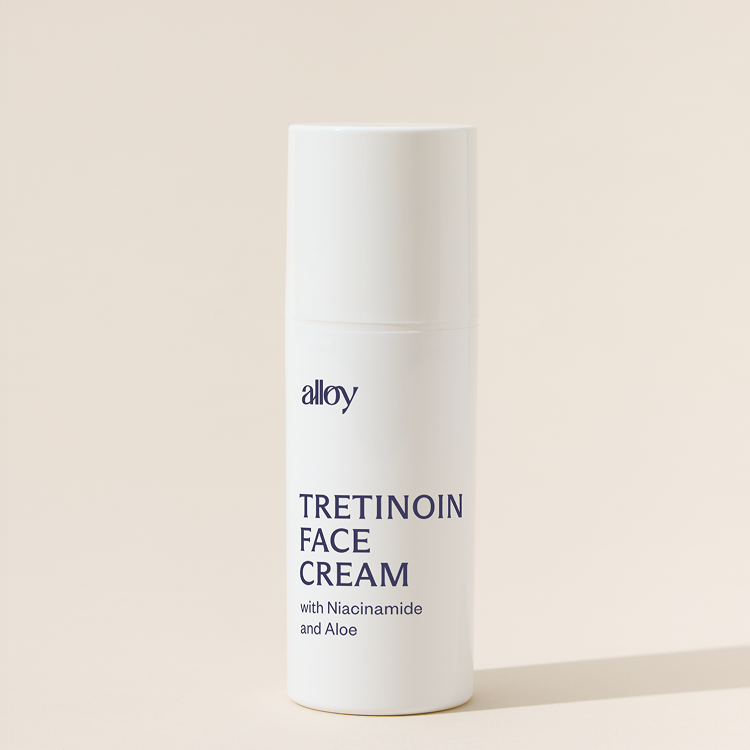
That’s why it’s so important to buy products that combine tretinoin with barrier-supportive ingredients, like niacinamide or aloe, as it can make your treatment more tolerable.
“Alloy’s tretinoin does just that! Uniquely formulated with Aloe and niacinamide, to decrease inflammation and irritation it combines beautifully with our M4 skin care line for those seeking long-term anti- aging solutions”. ~ Dr Sheila Boyle, Board Certified Dermatologist with Alloy
Frequency matters too.
For some women, using tretinoin two or three nights a week to start works far better than diving right into near-nightly use. Think of tretinoin as a long-term skincare product. You won’t notice dramatic improvements after the first one or two applications.
Also, if there’s one thing you must absolutely remember to do while using retinoids of any kind, it’s to use SPF. Tretinoin can make your skin even more sensitive to the sun, so it’s important to lather up on sunscreen and reapply often to protect your skin.
What Does Hydroquinone Do?
Hydroquinone is primarily used to treat hyperpigmentation. That includes melasma, sun spots, and post-inflammatory marks left behind after acne or irritation.
It works by inhibiting tyrosinase, an enzyme involved in melanin production. In other words, it helps slow down the process that creates excess pigment in the skin.
Unlike tretinoin, hydroquinone doesn’t improve wrinkles, skin firmness, or texture. At least, not directly. It’s also not designed to be used forever. Many clinicians prescribe hydroquinone in short cycles to reduce the risk of irritation or rebound pigmentation.
Similar to tretinoin, sun protection is non-negotiable while using this prescription skincare product! Without sunscreen, UV exposure can quickly undo your progress and worsen discoloration. Effective sun protection is the foundation of any anti-aging regimen.
Niacinamide: A Barrier‑Supporting Ingredient for Midlife Skin
Sure, niacinamide (a form of vitamin B3) isn’t a powerful prescription-based ingredient like tretinoin or hydroquinone, but that doesn’t make it any less important. In fact, it helps lower the risk of side effects from active ingredients.
Think of niacinamide as a natural anti-inflammatory and a great foundation of a skincare routine. While stronger actives target acne or hyperpigmentation, niacinamide helps reinforce the skin barrier, calm irritation, improve moisture retention, address uneven skin tone, and soften the appearance of pores.
You can layer it easily into your skincare routine as it’s mild and doesn’t often interact with other products.
Can You Use Hydroquinone, Tretinoin, and Niacinamide Together?
You can, but that doesn’t necessarily mean you need all three.
In some cases, dermatologists or clinicians may recommend combining them for specific concerns, like melasma or stubborn hyperpigmentation. But if you jump into multiple strong active ingredients too quickly, your skin may act up.
This is especially true during perimenopause and menopause, when skin tends to become drier and more reactive overall. If you’re using both tretinoin and hydroquinone, alternating them on different nights can help ease your skin into the routine instead of overwhelming it right away.
And honestly, part of skincare at this stage is figuring out what your skin can realistically tolerate. Some women tolerate tretinoin nightly. Others find every other night is their sweet spot, even months into their routine. Same with hydroquinone. Some people use it all over, while others prefer keeping it just on dark spots.
Niacinamide can help balance things out a bit. Since it supports the skin barrier and helps with moisture retention, it may make stronger prescription ingredients feel less irritating over time.
Also, don’t skip moisturizer! Midlife skin tends to lose hydration faster, and when your skin barrier is struggling, everything can suddenly feel harsher than it used to. Sometimes the difference between “this product ruined my skin” and “this product works great” is simply whether your skin is moisturized enough to tolerate it.
Why Midlife Skin Gets Irritated More Easily
Products you once swore by may now leave your skin feeling tight, dry, irritated, or oddly sensitive. Even certain cleansers can start feeling too harsh.
A lot of this comes back to, yes, you guessed it, estrogen. As levels decline, your skin barrier weakens and loses moisture more easily, making it less resilient overall and more reactive to those aforementioned active ingredients.
So if tretinoin suddenly feels intense or a product starts stinging out of nowhere, it doesn’t necessarily mean your skin is “bad.” Your barrier may just need more support than it used to, and that’s okay.
This is why easing slowly into stronger products matters so much during midlife. Lower strengths, fewer application nights, and a solid moisturizer can make a huge difference in how well your skin adjusts.
When To Talk to a Clinician
There’s a big difference between normal skincare frustration and skin concerns that just won’t quit.
If you’re dealing with melasma that keeps spreading, acne that keeps coming back, discoloration that isn’t fading, or irritation that never fully settles down, it may be worth reaching out to one of our Alloy physicians.
Prescription ingredients like tretinoin and hydroquinone can be incredibly effective, but they’re not always right for everyone, especially during perimenopause and menopause when things are already a bit more sensitive.
Our clinicians at Alloy can help you figure out what’s worth trying for your specific skin concerns, how to introduce products while still protecting the integrity of your skin barrier, and whether your current routine is helping or quietly making things worse.
“To ensure your skincare strategy is as advanced as the science behind it; reach out to one of our Alloy physicians today for a personalized skin care routine to help you navigate your skin health journey” ~ Dr Sheila Boyle, Board Certified Dermatologist with Alloy.
Frequently Asked Questions
Why does skin become more sensitive and prone to irritation during perimenopause and menopause?
As women navigate the transition into perimenopause and menopause, declining estrogen levels directly impact the skin. Estrogen plays a vital role in supporting collagen production, hydration, elasticity, and barrier function. When these hormone levels drop, the skin barrier naturally weakens, loses moisture much faster, and becomes thinner and less resilient. This hormonal shift is why your skin might suddenly feel tight, dry, or unusually reactive to cleansers and active ingredients that used to work perfectly fine.
How do tretinoin, hydroquinone, and niacinamide work differently to support midlife skin?
These three ingredients form a supportive trio that targets distinct skin concerns brought on by aging and hormonal shifts. Tretinoin is a vitamin A derivative that accelerates cell turnover and stimulates collagen molecularly to improve fine lines, texture, and adult acne. Hydroquinone specifically targets hyperpigmentation, like sun spots and melasma, by slowing down the enzyme responsible for excess melanin production. Niacinamide acts as the soothing foundation of the routine, reducing inflammation, reinforcing the fragile skin barrier, and enhancing moisture retention so the skin can actually tolerate the stronger prescription ingredients.
What is the safest way to introduce these active ingredients into a midlife skincare routine?
Because midlife skin lacks its usual resilient sidekick, estrogen, it is crucial to introduce powerful prescription products low and slow. Clinicians recommend starting tretinoin or hydroquinone just two or three nights a week rather than diving into nightly use, or even alternating them on different nights to avoid overwhelming the skin barrier. Additionally, you should look for formulations that blend strong actives with anti-inflammatory ingredients like aloe or niacinamide, never skip a heavy moisturizer to lock in hydration, and absolutely commit to daily sunscreen use since these ingredients make the skin highly sensitive to UV damage.
Related Content
Citations
Kendra Gail Bergstrom. Beyond tretinoin: cosmeceuticals for aging skin. J Drugs Dermatol 2009;8(7):674-7. PMID:19588645.
View sourceW F Bergfeld. A lifetime of healthy skin: implications for women. Int J Fertil Womens Med 1999;44(2):83-95. PMID:10338266.
View sourceA M Kligman. Postmenopausal acne. Cutis 1991;47(6):425-6. PMID:1831742.
View sourceChi-Feng Hung, Wei-Yu Chen, Ibrahim A Aljuffali, Yin-Ku Lin, Hui-Chi Shih, Jia-You Fang. Skin aging modulates percutaneous drug absorption: the impact of ultraviolet irradiation and ovariectomy. Age (Dordr) 2015;37(2):21. PMID:25721687.
View sourceWójcik A, Bartnicka E, Namieciński P, Rotsztejn H. Influence of the complex of retinol-vitamin C on skin surface lipids. J Cosmet Dermatol. 2015;14(2):92-9. PMID:25810364.
View sourceFabi SG, Firsowicz M, Kamrani P, Draelos ZD, Dayan SH. Round Table Discussion: Aesthetic Treatment Considerations for the Perimenopausal & Menopausal Patient. J Cosmet Dermatol. 2026;25(1):e70626. PMID:41461019.
View source
Subscribe
Go ahead, you deserve to
feel fantastic
By subscribing you agree to our Terms of Service & Privacy Policy.