Progesterone vs. Progestin in Menopause: What's the Difference?
7 minute read

Summary
Progesterone and synthetic progestins are both progestogens, but they are not identical medications and can differ in tolerability, effects, and supporting safety evidence. For women with a uterus, an adequately dosed progestogen is generally paired with systemic estrogen to protect the uterine lining. The right formulation and schedule depend on factors including menopause stage, bleeding pattern, estrogen dose, health history, contraception needs, and individual response.
Progesterone and progestin are sometimes used interchangeably, but they’re not exactly the same thing. Both can play an important role in menopause care, particularly if you’re taking estrogen and still have a uterus. But they differ in how they’re made, how they affect your body, and the side effects you might experience.
So, does it matter which one you take? Here’s what to know about each.
What’s the Difference Between Progesterone and Progestin?
Progestogen is the umbrella term for hormones and medications that act like progesterone. This includes both progesterone itself and synthetic versions called progestins.
Your body naturally produces progesterone, primarily after ovulation. It helps regulate your menstrual cycle and prepares your uterine lining for a possible pregnancy. During perimenopause, your body naturally produces less progesterone as ovulation becomes less frequent and predictable.
In menopause care, doctors often prescribe micronized progesterone, a medication that’s chemically identical (also called bioidentical) to the progesterone your body produces. Progestins, meanwhile, are synthetic medications designed to produce progesterone-like effects. Examples include medroxyprogesterone acetate, norethindrone, and levonorgestrel. They’re used in both hormone replacement therapy (HRT) and birth control.
But don’t assume bioidentical automatically means more natural or “better.” At the end of the day, your body may simply respond better to one than the other.
Why Do You Need Progesterone or Progestin With Estrogen?
If you’re taking systemic estrogen and still have a uterus, you’ll generally need progesterone or a progestin alongside it.
Here’s why: Estrogen stimulates the growth of your uterine lining, called the endometrium. Without enough progesterone or progestin to balance that effect, the lining can become excessively thick, which is called endometrial hyperplasia and can raise the risk of uterine cancer over time.
An appropriately prescribed progestogen helps protect against that buildup. This applies whether your estrogen comes from a pill, patch, gel, or spray.
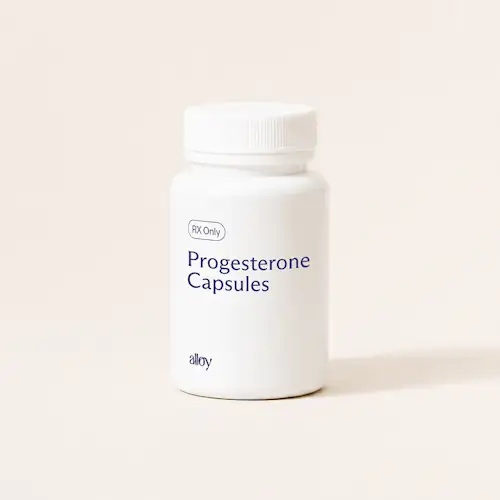
Progesterone
Starting at $23 /month
If you’ve had a hysterectomy, you typically don’t need progesterone specifically for uterine protection. And if you’re only using low-dose vaginal estrogen for dryness or pain during sex, progesterone generally isn’t necessary.
Certain progestin-releasing IUDs may also provide uterine protection as part of an HRT regimen.
“Not all progesterone products can reliably protect your uterine lining,” says Kathryn Williams, MD. “For example, progesterone creams applied to your skin may not deliver enough of the hormone to do the job. Progesterone is a large molecule and not well-absorbed through the skin. That’s why menopause-specialized doctors typically prescribe a proven option, such as oral micronized progesterone, alongside systemic estrogen.”
Does Micronized Progesterone Work Differently From Progestins?
Both options can protect your uterine lining when prescribed at appropriate doses, but they may feel different to take.
Oral micronized progesterone can have a calming, sedating effect, which some women find helpful when sleep becomes difficult during menopause. “However, it may cause side effects like grogginess, bloating or dizziness,” says Dr. Williams. “These side effects typically improve with continued use, but some women may not tolerate micronized progesterone.” For these women, a synthetic progestin may be the best option to reduce side effects and protect the uterine lining, she adds.
Synthetic progestins don’t all have the same effects, either. Some may be useful for managing irregular bleeding, while others are available in contraceptive methods or combined hormone therapy products.
If you don’t tolerate one medication well, that doesn’t mean every progestogen will cause the same problems.
Can Progesterone Help You Sleep?
It can for some women. A 2021 systematic review and meta-analysis found that micronized progesterone improved certain aspects of sleep, including helping women fall asleep faster. However, the benefits weren’t consistent across all sleep measures.
There’s also a catch: Most participants were postmenopausal, and some studies included estrogen therapy, so it’s hard to know how much of the improvement came from progesterone alone.
Oral micronized progesterone can make you drowsy, which is why it’s typically taken at bedtime. “Micronized progesterone may help improve sleep because it has a naturally calming effect on the brain,” Dr. Williams says.
Side Effects of Progesterone and Progestins
Like most medications, progesterone and progestins can come with side effects.
With micronized progesterone, you might notice drowsiness, dizziness, breast tenderness, bloating, headaches, or mood changes. Some women also feel groggy the next morning.
Synthetic progestins can also cause breast tenderness, headaches, mood changes, and changes in bleeding patterns, although the effects vary by medication.
And more isn’t necessarily better. Higher progesterone doses can increase certain side effects without providing additional benefits. If something feels off, don’t assume you have to abandon HRT altogether. Your doctor may be able to adjust your dose, change your dosing schedule, or recommend a different progestogen while keeping uterine protection front and center.
How Do Progesterone and Progestins Compare on Safety?
Some research suggests micronized progesterone may have a more favorable safety profile than certain synthetic progestins when it comes to breast cancer risk, but the evidence isn’t definitive.
For example, a 2018 systematic review published in Climacteric found no demonstrated increase in breast cancer risk among women taking estrogen with micronized progesterone for up to five years. However, researchers noted that evidence on longer-term use was limited.
The Women’s Health Initiative (WHI) randomized trials painted a different picture for one particular synthetic progestin. Women taking conjugated equine estrogen combined with medroxyprogesterone acetate had a higher incidence of breast cancer than those taking a placebo. Still, that finding doesn’t mean all synthetic progestins carry the same risk, or that micronized progesterone is automatically the safer choice.
While observational studies suggest there may be differences in breast cancer risk between formulations, randomized trials haven’t confirmed that micronized progesterone is safer than synthetic progestins.
Your age, personal health history, the type of estrogen you’re taking, and how long you plan to use HRT all matter when weighing the risks and benefits.
How Is Progestin Birth Control Different From Menopause HRT?
Progestins aren’t just used in HRT. They’re also found in birth control pills, hormonal IUDs, and other contraceptives. So, how does their role change depending on what you’re taking them for?
In HRT, progesterone or a progestin is often prescribed to protect your uterine lining while estrogen helps relieve menopause symptoms.
In birth control, progestins primarily help prevent pregnancy. Some options can also help manage heavy or irregular periods, which can be especially helpful during perimenopause. But progestin-only birth control doesn’t replace declining estrogen, so it won’t necessarily relieve hot flashes or night sweats the way systemic estrogen can.
And one friendly reminder: Menopause HRT isn’t birth control. If you’re still in perimenopause, pregnancy is possible even if your periods have become irregular.
So, Which Option Is Right for You?
There’s no one-size-fits-all answer when it comes to choosing between micronized progesterone and a synthetic progestin. Both have their benefits, and the best choice depends on your individual needs, preferences, and health history.
For example, if you’re struggling with sleep, oral micronized progesterone may offer an additional benefit. If you also need birth control or help managing irregular bleeding, certain synthetic progestins may be worth considering.
Your doctor can help you weigh these factors alongside your medical history, whether you still have a uterus, and how you respond to treatment. Alloy Health connects you with a menopause-specialized doctor who can help you find the option that fits you.
Frequently Asked Questions
What is the difference between progesterone and progestin, and why are they needed with estrogen?
Progestogen is the umbrella term for hormones and medications that act like progesterone, encompassing both micronized progesterone and synthetic progestins. Micronized progesterone is chemically identical (bioidentical) to the hormone your body naturally produces after ovulation, while progestins—such as medroxyprogesterone acetate, norethindrone, and levonorgestrel—are synthetic medications designed to produce progesterone-like effects. If you still have a uterus and take systemic estrogen via a pill, patch, gel, or spray, an adequately dosed progestogen is generally paired with it to prevent the uterine lining from overgrowing into endometrial hyperplasia, which can raise the risk of uterine cancer. Women who have had a hysterectomy or who only use low-dose vaginal estrogen typically do not need a progestogen for uterine protection.
How do micronized progesterone and synthetic progestins compare on sleep, side effects, and safety?
Oral micronized progesterone has a naturally calming effect on the brain that can help some women fall asleep faster, which is why it is usually taken at bedtime, though it can also cause next-day grogginess, drowsiness, dizziness, bloating, breast tenderness, headaches, or mood changes. Synthetic progestins can similarly cause breast tenderness, headaches, mood changes, and changes in bleeding patterns, and may be recommended if you do not tolerate micronized progesterone well or need help managing irregular bleeding. Regarding long-term safety, observational studies suggest micronized progesterone may have a more favorable breast cancer risk profile than certain synthetic progestins like medroxyprogesterone acetate, though randomized clinical trials have not definitively confirmed that micronized progesterone is safer.
How is progestin birth control different from menopause hormone replacement therapy (HRT)?
Although progestins are used in both contraceptives and menopause hormone therapy, their primary roles differ. In HRT, progesterone or a progestin is prescribed alongside estrogen to protect the uterine lining while systemic estrogen treats menopause symptoms. In birth control methods like pills or hormonal IUDs, progestins primarily work to prevent pregnancy and can help manage heavy or irregular periods during perimenopause, but progestin-only contraception does not replace declining estrogen or reliably relieve hot flashes and night sweats. Additionally, menopause HRT does not prevent pregnancy, meaning contraception is still necessary during perimenopause if you wish to avoid pregnancy.
Related Content
https://www.myalloy.com/blog/what-is-the-lowest-dose-of-progesterone-for-hrt
https://www.myalloy.com/blog/estradiol-pill-dosage-for-menopause
https://www.myalloy.com/blog/is-progesterone-better-for-sleep-than-sleeping-pills
https://www.myalloy.com/blog/understanding-endometrial-hyperplasia-in-menopause-what-is-normal
https://www.myalloy.com/blog/heres-what-you-need-to-know-about-the-new-otc-birth-control-pill-and
https://www.myalloy.com/blog/bioidentical-hormone-replacement-therapy-insiders-guide
Citations
Nick Panay, Anna Fenton, Haitham Hamoda, Timothy Hillard, Rakibul Islam, Hugo Pedder, et al.. International Menopause Society (IMS) recommendations and key messages on women's midlife health and menopause. Climacteric 2025;28(6):634-656. doi:10.1080/13697137.2025.2585487. PMID:41433054.
View sourceThe 2022 hormone therapy position statement of The North American Menopause Society. Menopause 2022;29(7):767-794. PMID:35797481.
View sourceAnne Gompel, Richard Simcock. Menopausal hormone treatment and breast cancer. Lancet Diabetes Endocrinol 2026;14(3):259-274. doi:10.1016/S2213-8587(25)00394-8. PMID:41619758.
View sourceBrendan J Nolan, Bonnie Liang, Ada S Cheung. Efficacy of Micronized Progesterone for Sleep: A Systematic Review and Meta-analysis of Randomized Controlled Trial Data. J Clin Endocrinol Metab 2021;106(4):942-951. doi:10.1210/clinem/dgaa873. PMID:33245776.
View sourceRowan T Chlebowski, Garnet L Anderson, Aaron K Aragaki, JoAnn E Manson, Marcia L Stefanick, Kathy Pan, et al.. Association of Menopausal Hormone Therapy With Breast Cancer Incidence and Mortality During Long-term Follow-up of the Women's Health Initiative Randomized Clinical Trials. JAMA 2020;324(4):369-380. doi:10.1001/jama.2020.9482. PMC:PMC7388026. PMID:32721007.
View sourceP Stute, L Wildt, J Neulen. The impact of micronized progesterone on breast cancer risk: a systematic review. Climacteric 2018;21(2):111-122. doi:10.1080/13697137.2017.1421925. PMID:29384406.
View sourceThe 2020 genitourinary syndrome of menopause position statement of The North American Menopause Society. Menopause 2020;27(9):976-992. PMID:32852449.
View sourceJ Bitzer. Overview of perimenopausal contraception. Climacteric 2019;22(1):44-50. doi:10.1080/13697137.2018.1540566. PMID:30562124.
View sourceEva Dreisler, Christian Seerup Frandsen, Lian Ulrich. Perimenopausal abnormal uterine bleeding. Maturitas 2024;184:107944. PMID:38412750.
View source
Subscribe
Go ahead, you deserve to
feel fantastic
By subscribing you agree to our Terms of Service & Privacy Policy.