M4Ⓡ Skin Cream vs. Musely Anti-Aging Cream
7 minute read
Summary
Comparison of M4 Skin Cream and Musely Anti-Aging Cream for menopause-related skin changes such as dryness, thinning, and wrinkles linked to declining estrogen during perimenopause and menopause. Alloy’s formula uses topical estriol to support collagen production, hydration, and skin thickness locally without systemic hormone exposure, while Musely relies on tretinoin, hyaluronic acid, and niacinamide to increase cell turnover and treat acne, discoloration, and fine lines. Key considerations include mechanism of action, potential irritation, expected results over time, and how these treatments may complement broader menopause skin care.
Introduction: The Menopause Skin Gap
For many women, menopause can come with a lot of changes, including major changes in how our skin looks and feels. During midlife, skin might seem drier, thinner, less supple, and more crepey—it can be gradual, or happen (seemingly) overnight.
Sure, it’s easy to chalk these changes up to “just aging.” And while sun exposure and time do play a role, there’s another equally important factor: declining estrogen.
During perimenopause, estrogen levels fluctuate and then fall once you reach menopause. At the same time, skin starts producing less collagen, natural oil, and hyaluronic acid. All of these things are interrelated. In fact, estrogen loss directly leads to a 30 percent drop in collagen in the first five years of menopause.
With less estrogen and collagen, you might notice those skin changes we mentioned:
Dryness
Itchiness
Thinning and crepiness
Less elasticity and suppleness
More fine lines and wrinkles
This is partly why a skincare routine that worked for years can all of a sudden feel like it’s not getting the job done anymore. So, where do you go from here? It helps to understand that not all “anti-aging” products work the same way, and it usually comes down to their main ingredients.
For example, many creams focus on improving the skin’s surface, while menopause-focused treatments aim to address one of the root causes underneath: estrogen deficiency.
Ahead, we’ll compare two popular options—Musely Anti-Aging Cream and Alloy M4Ⓡ Face Cream—to see how each approaches menopausal skin changes.
How Alloy M4® Face Cream Works
Let’s start by breaking down the details of the Alloy M4Ⓡ Face Cream, a low-dose estrogen cream for areas like the face, skin, neck, and chest.
The main ingredient is a weaker form of estrogen called estriol. Because it doesn’t bind as strongly to estrogen receptors as other forms (like estradiol), estriol tends to have more gentle effects. This is partly what makes it great in a topical, local treatment, like Alloy M4.
Alloy M4 is prescribed to target the effects of lower estrogen levels during menopause in the skin. Unlike systemic forms of hormone replacement therapy (HRT), it acts locally. This means it’s only absorbed directly where it’s applied, so it can support skin health without impacting the rest of your body.
Estriol cream works by supporting collagen production for plumpness and helping the skin retain moisture. Over time, this can help improve overall texture and elasticity.
Some women use it on its own while others may choose to fold it into a larger perimenopause and menopause care plan, depending on their menopause symptoms and health goals.

M4 Face Cream Rx
Estriol
$150.00
What’s the Difference Between M4 vs. Musely Anti-Aging Cream?
So, how does Musely’s Anti-Aging Cream compare to Alloy M4? The primary difference is the key anti-aging ingredient, and what skin concerns they’re designed to treat.
Musely’s formula centers on tretinoin, a prescription retinoid derived from vitamin A that works by stimulating collagen and improving cell turnover.
It can be great for treating acne and the appearance of fine lines, but many people also find it can be irritating. Redness, dryness, peeling, and the so-called “tretinoin purge” are all common during the adjustment period.
That said, a tretinoin-based treatment like Musely’s and Alloy M4 isn’t necessarily an either-or choice. Alloy M4 is designed to address menopausal skin changes at a structural level by helping restore estrogen locally in the skin, which can improve thickness, hydration, and crepiness. Tretinoin, on the other hand, focuses on increasing cell turnover and stimulating collagen production to improve wrinkles, acne, and any discoloration.
So, for some women, the two can actually be used together and complement each other. While M4 can deliver hydration and support the skin barrier, tretinoin can target fine lines and acne.
Do Alloy M4 and Musely Anti-Aging Creams Work? What the Research Says
In a 12-week study, Alloy’s estriol cream showed measurable improvements, like an immediate boost in skin hydration for 17.7 percent of participants (which means they noticed the improvement right after applying it. And, by the end of the study, 97 percent of users reported that their skin felt more hydrated.
Skin elasticity also seemed to get better, with 88 percent of participants experiencing improved elasticity after 12 weeks.
Another important callout: All of these improvements were reported without any meaningful increase in blood estrogen levels, suggesting that estriol works locally on the skin instead of impacting the whole body.
Musely’s Anti-Aging Cream hasn’t been studied in published clinical trials, but its individual ingredients are pretty well established.
For example, hyaluronic acid helps attract and retain moisture, while tretinoin is backed by decades of research showing improvements in fine lines, acne, and uneven skin texture.
It also contains niacinamide, an ingredient that’s linked to improved skin barrier function and tone. That’s why it’s often found in products designed to treat acne, melasma, and psoriasis.
Alloy M4 vs. Musely Anti-Aging Cream: How They Compare
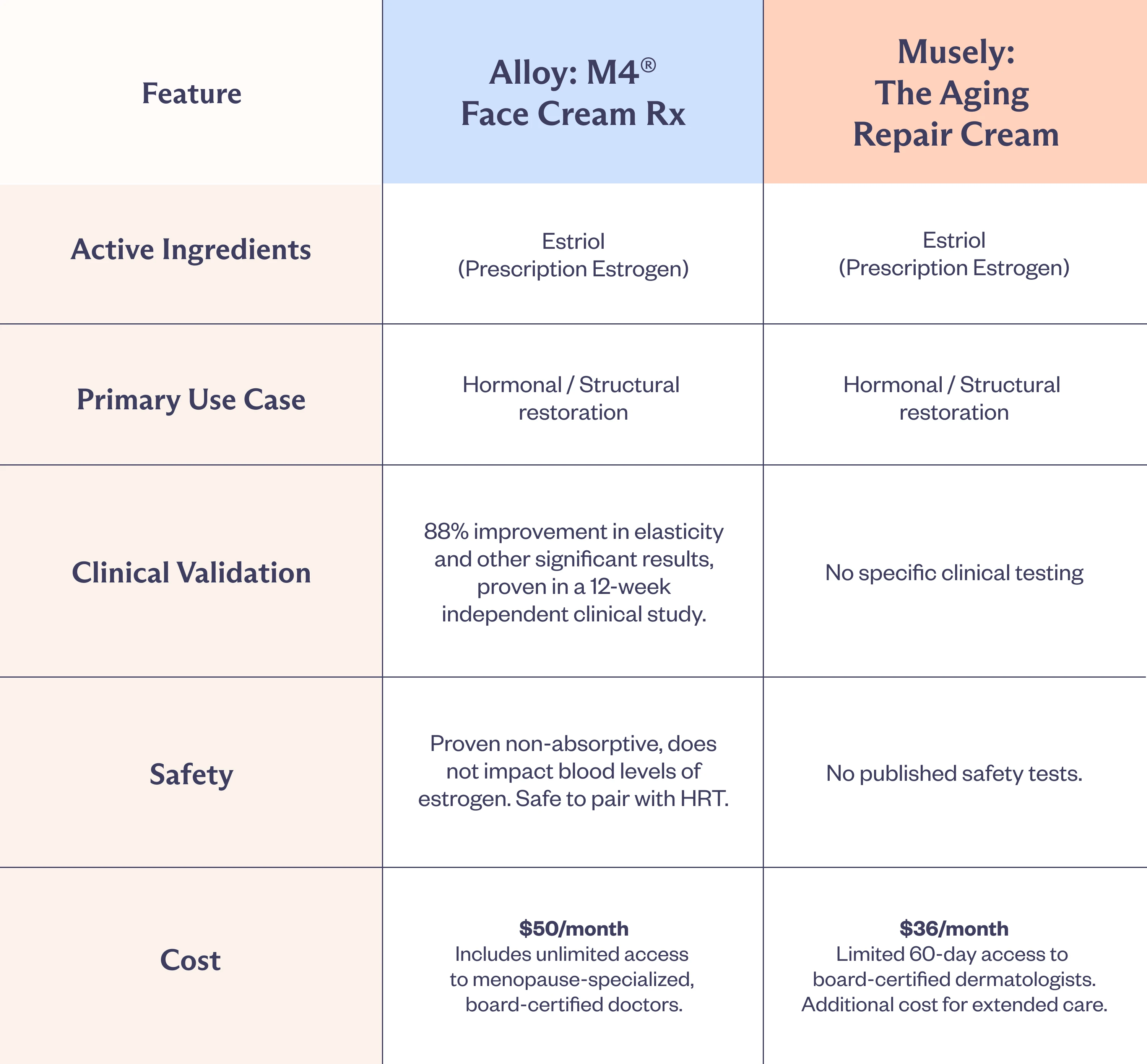
Here’s a side-by-side glance at how the two face cream options differ:
How M4 Elevates the Prescription Experience
Some prescription creams feel exactly like what they are: medicine. In other words, they’re effective (which is great!), but not especially elegant. Alloy M4 was designed to bridge that gap.
For starters, the texture is lightweight and silky, so it feels more like a high-end facial treatment than what you might expect from a prescription cream. It also absorbs easily and can layer well with the rest of your products, so it doesn’t feel like one more step in your routine that messes with other skincare you love.
As for application, you just rub it in once a day on the places where thinning, crepiness, and loss of firmness are most noticeable. For many women, that means applying it to the face and neck.
And getting started is straightforward. Alloy includes a no-cost online consultation with menopause-specialized clinicians, who review your symptoms and medical history to determine whether M4 is a good fit.
Long story short, M4 combines the efficacy of prescription treatment with the quality and experience of a product you’ll actually look forward to using.
Setting Expectations: What Changes, and When
As much as we all love immediate results, skin simply doesn’t heal and rebuild overnight. It usually takes time to start noticing whether a product really works.
That being said, many women notice that M4 starts working in stages. In the first few days to weeks, the most immediate change is often hydration. Skin may feel softer, less tight, and just generally more comfortable.
By around the one-month mark, texture may start to get better. Specifically, skin can look smoother and feel a little more supple.
And then the more meaningful structural changes tend to take longer. Over the next two to three months, as estriol helps support collagen production and skin thickness, many women notice more “bounce,” more firmness, and less noticeable crepiness.
“If you’re ready to explore options for menopausal skin changes or other skin concerns, Alloy can connect you with menopause-specialized clinicians who will recommend personalized treatment options designed to support healthy aging and help optimize your skincare regime”. ~ Dr Sheila Boyle, Board Certified Dermatologist with Alloy.
Frequently Asked Questions
What is the difference between Alloy M4Ⓡ and Musely Anti-Aging Cream?
The primary difference lies in the active ingredients and how they target aging. Musely’s formula focuses on tretinoin, a potent retinoid that accelerates cell turnover and treats surface issues like acne and fine lines, though it can often cause irritation or peeling. Alloy M4Ⓡ uses estriol, a gentle form of estrogen that targets the structural "menopause skin gap." Rather than just exfoliating the surface, M4Ⓡ works locally to address the 30% drop in collagen that occurs during the first five years of menopause, improving thickness and hydration from the inside out.
Can I use Alloy M4Ⓡ and tretinoin-based creams like Musely together?
Yes, these two treatments can actually be complementary. While tretinoin (found in Musely) focuses on stimulating collagen and clearing surface imperfections, it can be quite drying. Alloy M4Ⓡ helps restore the skin barrier and deliver deep hydration by addressing estrogen deficiency locally. Using them together allows you to target fine lines and acne with tretinoin while using M4Ⓡ to provide the hormonal support and moisture needed to maintain skin resilience and "bounce" during menopause.
How quickly will I see results with an estriol-based face cream?
Results with Alloy M4Ⓡ typically occur in stages as the skin's structure rebuilds. In the first few days and weeks, most women notice an immediate boost in hydration and softness. By the one-month mark, skin texture often becomes smoother and more supple. The most significant structural changes, such as increased firmness and reduced crepiness, generally become visible between two and three months, as this is the time required for the skin to biologically respond and support new collagen production.
References:
Viscose BI, et al. (2025). Managing menopausal skin changes: A narrative review of skin quality changes, their aesthetic impact, and the actual role of hormone replacement therapy in improvement. https://pmc.ncbi.nlm.nih.gov/articles/PMC12374573/ Ali EM, et al. (2017). Estriol: emerging clinical benefits. https://journals.lww.com/menopausejournal/abstract/2017/09000/estriol__emerging_clinical_benefits.15.aspx
Yoham AT, et al. (2023). Tretinoin. https://www.ncbi.nlm.nih.gov/books/NBK557478/
Citations
Ali EM, et al. (2017). Estriol: emerging clinical benefits. Hardwood AN, et al. (2024). Moisturizers.
View sourceMarques CI, et al. (2024). Mechanistic insights into the multiple functions of niacinamide: Therapeutic implications and cosmeceutical applications in functional skincare products.
View sourceNappi RE, et al. (2023). Different local estrogen therapies for a tailored approach to GSM.
View sourceRzepecki AL, et al. (2019). Estrogen-deficient skin: The role of topical therapy.
View sourceThornton JU. (2013). Estrogens and aging skin.
View source
Subscribe
Go ahead, you deserve to
feel fantastic
By subscribing you agree to our Terms of Service & Privacy Policy.