Menopause Hip Pain: Causes, Relief, and When to See a Doctor
5 minute read

Summary
Menopause hip pain can occur as fluctuating and declining estrogen during perimenopause and menopause affects muscles, tendons, connective tissues, and joint health, although osteoarthritis, greater trochanteric pain syndrome, and osteoporosis can also cause hip discomfort. For women experiencing midlife hip pain, management may include exercise, physical therapy, sleep improvement, and short-term pain relief, while hormone replacement therapy (HRT) may reduce joint pain for some women; severe, worsening, or unexplained pain warrants medical evaluation.
Why Hip Pain Can Show Up During Menopause
If your hips have started to hurt when you get out of bed, climb the stairs, or go for a walk, you might be wondering whether menopause has something to do with it. It might. Hip pain has several possible causes, but changing hormone levels during perimenopause and menopause can contribute to joint and muscle aches. Estrogen helps support the tissues around your joints, so as it fluctuates and declines, you may notice aches that weren’t there before.
What Estrogen Has to Do with Your Hips
The discomfort you're experiencing doesn't necessarily start in the hip joint itself. As estrogen levels decline, changes in your muscles and connective tissues may affect how your hips respond to everyday activities like walking, climbing stairs, or lifting objects. The tendons and other tissues surrounding the joint can also be sources of pain. That's one reason hip pain can feel different from one woman to another.
Although we know estrogen plays a role in musculoskeletal health, researchers are still working to understand exactly how hormonal changes during menopause affect joint pain in individual women.
How Long Does Menopause Hip Pain Last?
Like many symptoms of perimenopause, hip and joint pain doesn't follow a predictable timeline. Perimenopause can last for years, and you may find that your aches and pains come and go throughout the transition. For some women, joint pain can continue even after menopause.
When Hip Pain Might Be Something Else
Not every ache or pain during midlife is caused by menopause. Conditions like osteoarthritis or problems with the muscles, tendons, and other tissues surrounding your hip can also cause discomfort.
For example, pain on the outside of your hip may be caused by a condition called greater trochanteric pain syndrome, which often involves the gluteal tendons rather than the hip joint itself. Inflammatory conditions or pain originating elsewhere in the body can also contribute to hip discomfort.
Bone loss accelerates around menopause, increasing the risk of osteoporosis and fractures. If you're experiencing significant or unexplained hip pain, it's worth talking to your healthcare provider. Sudden or severe pain, difficulty bearing weight, fever, or pain that continues to worsen should also be evaluated.
What Helps to Improve Hip Pain in Midlife
Staying active and keeping your muscles strong can help support your mobility and joint health during midlife. Exercise has also been shown to improve pain and function in women with greater trochanteric pain syndrome. Physical therapy can help identify muscle weakness, movement limitations, or activities that may be putting extra strain on your hips and develop an exercise plan that works for you.
If your hips are hurting, that doesn't mean you have to give up exercising. Shorter workouts, lower-impact activities, and gradually increasing your activity may be more comfortable than pushing through an intense workout or doing too much too quickly.
Poor sleep can also make pain feel worse, so improving your sleep may be another helpful part of managing hip discomfort. Depending on your medical history and other medications, short-term over-the-counter pain relief may also be an option.
Can Hormone Therapy Help Joint and Hip Pain?
Some women notice that their joint and muscle pain improves with hormone replacement therapy (HRT), and research suggests estrogen may help reduce joint pain in some women. HRT is an established treatment for menopause symptoms like hot flashes and night sweats, but it isn't prescribed specifically for hip pain. Whether HRT is right for you depends on your menopause symptoms, age, medical history, individual risks, and treatment preferences.
“If you’re experiencing new hip or joint pain during perimenopause or menopause along with other symptoms, a trial of hormone replacement therapy (HRT) may be reasonable. Some women notice improvement as estrogen levels are stabilized. Joint pain can take several weeks or even longer to improve, so it’s worth giving HRT some time; however, if pain persists or worsens despite treatment, it’s important to look for other contributing factors rather than assuming hormones are the cause.” – Kathryn Williams, MD, MSCP, DABOM
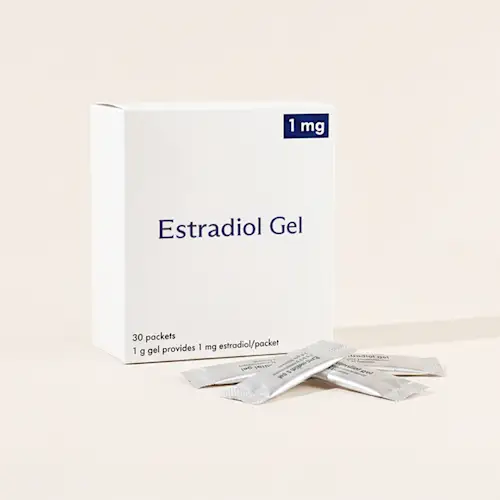
Estradiol Gel
$69.99 /month
There’s still more to learn about how estrogen affects joint and hip pain, but you don’t have to wait for answers to find relief. Your doctor can help you figure out what’s contributing to your pain, so you can stay active while you treat it.
Frequently Asked Questions
How does menopause cause or contribute to hip pain?
Estrogen plays an important role in musculoskeletal health by supporting the tissues surrounding your joints. As estrogen fluctuates and declines during perimenopause and menopause, changes in muscles, tendons, and connective tissues can alter how your hips respond to everyday movements like walking, lifting, and climbing stairs. Because the discomfort often originates in the surrounding soft tissues rather than the hip joint itself, the aches can come, go, and feel different from person to person throughout the menopause transition.
What other conditions cause hip pain in midlife, and when should you see a doctor?
Not all midlife hip discomfort is hormonal. Pain on the outside of the hip is frequently linked to greater trochanteric pain syndrome involving the gluteal tendons, while osteoarthritis, inflammatory conditions, and accelerated bone loss from osteoporosis can also be underlying factors. You should consult a healthcare provider if you experience significant, unexplained, or progressively worsening hip pain, and seek immediate evaluation if you have sudden or severe pain, difficulty bearing weight, or an accompanying fever.
Can hormone replacement therapy (HRT) relieve menopausal hip pain?
Hormone replacement therapy is not prescribed specifically to treat hip pain, but research indicates estrogen can reduce joint discomfort for some women as hormone levels stabilize. A trial of HRT may be considered if you have hip aches alongside other menopause symptoms. Because joint pain can take several weeks or longer to respond to estrogen, pain that continues or intensifies despite treatment warrants further medical evaluation to investigate other non-hormonal causes.
References
Lu CB, Liu PF, Zhou YS, et al. Musculoskeletal pain during the menopausal transition: a systematic review and meta-analysis. Neural Plast. 2020;2020:8842110. doi:10.1155/2020/8842110
Watt FE. Musculoskeletal pain and menopause. Post Reprod Health. 2018;24(1):34-43. doi:10.1177/2053369118757537
Gulati M, Dursun E, Vincent K, Watt FE. The influence of sex hormones on musculoskeletal pain and osteoarthritis. Lancet Rheumatol. 2023;5(4):e225-e238. doi:10.1016/S2665-9913(23)00060-7
Strand NH, D'Souza RS, Gomez DA, et al. Pain during menopause. Maturitas. 2025;191:108135. doi:10.1016/j.maturitas.2024.108135
Ganderton C, Semciw A, Cook J, Moreira E, Pizzari T. Gluteal loading versus sham exercises to improve pain and dysfunction in postmenopausal women with greater trochanteric pain syndrome: a randomized controlled trial. J Womens Health (Larchmt). 2018;27(6):815-829. doi:10.1089/jwh.2017.6729
Kjeldsen T, Hvidt KJ, Bohn MB, et al. Exercise compared to a control condition or other conservative treatment options in patients with greater trochanteric pain syndrome: a systematic review and meta-analysis of randomized controlled trials. Physiotherapy. 2024. doi:10.1016/j.physio.2024.01.001
Chlebowski RT, Cirillo DJ, Eaton CB, et al. Estrogen alone and joint symptoms in the Women's Health Initiative randomized trial. Menopause. 2013;20(6):600-608. doi:10.1097/GME.0b013e318277f7be
The North American Menopause Society. The 2022 hormone therapy position statement of The North American Menopause Society. Menopause. 2022;29(7):767-794. doi:10.1097/GME.0000000000002028
American College of Obstetricians and Gynecologists. Management of postmenopausal osteoporosis: ACOG Clinical Practice Guideline No. 2. Obstet Gynecol. 2022;139(6):1081-1092. doi:10.1097/AOG.0000000000004798
Related Content
Citations
Chang-Bo Lu, Peng-Fei Liu, Yong-Sheng Zhou, Fan-Cheng Meng, Tian-Yun Qiao, Xiao-Jiang Yang, et al.. Musculoskeletal Pain during the Menopausal Transition: A Systematic Review and Meta-Analysis. Neural Plast 2020;2020:8842110. doi:10.1155/2020/8842110. PMC:PMC7710408. PMID:33299396.
View sourceFiona E Watt. Musculoskeletal pain and menopause. Post Reprod Health 2018;24(1):34-43. doi:10.1177/2053369118757537. PMID:29412042.
View sourceMalvika Gulati, Eren Dursun, Katy Vincent, Fiona E Watt. The influence of sex hormones on musculoskeletal pain and osteoarthritis. Lancet Rheumatol 2023;5(4):e225-e238. doi:10.1016/S2665-9913(23)00060-7. PMID:38251525.
View sourceVonda J Wright, Jonathan D Schwartzman, Rafael Itinoche, Jocelyn Wittstein. The musculoskeletal syndrome of menopause. Climacteric 2024;27(5):466-472. doi:10.1080/13697137.2024.2380363. PMID:39077777.
View sourceCharlotte Ganderton, Adam Semciw, Jill Cook, Euler Moreira, Tania Pizzari. Gluteal Loading Versus Sham Exercises to Improve Pain and Dysfunction in Postmenopausal Women with Greater Trochanteric Pain Syndrome: A Randomized Controlled Trial. J Womens Health (Larchmt) 2018;27(6):815-829. doi:10.1089/jwh.2017.6729. PMID:29715073.
View sourceChandima Hemachandra, Sasha Taylor, Rakibul M Islam, Ensieh Fooladi, Susan R Davis. A systematic review and critical appraisal of menopause guidelines. BMJ Sex Reprod Health 2024;50(2):122-138. PMID:38336466.
View sourceNatalie H Strand, Ryan S D'Souza, Diego A Gomez, Madeline A Whitney, Sumedha Attanti, Meredith A Anderson, et al.. Pain during menopause. Maturitas 2025;191:108135. doi:10.1016/j.maturitas.2024.108135. PMID:39500125.
View sourceColin Kruse, Tyler McKechnie, Joshua Dworsky-Fried, Aariz Sardar, Georgia Hacker, Sahaar Rattansi, et al.. Musculoskeletal Manifestations of Perimenopause: A Systematic Review and Meta-Analysis of 93,021 Women. JB JS Open Access 2026;11(1). doi:10.2106/JBJS.OA.25.00254. PMC:PMC12784006. PMID:41523660.
View source
Subscribe
Go ahead, you deserve to
feel fantastic
By subscribing you agree to our Terms of Service & Privacy Policy.